Twin Driver Coordination Racing

Reviews
Twin Driver Coordination Racing is a hypercasual title built around a single, demanding idea: control two cars simultaneously. The game avoids time limits and complex rules, making it accessible to a wide age range. Its difficulty comes from divided attention, not speed or reflexes alone. Players who enjoy multitasking puzzles will find a satisfying mental workout, while those who prefer traditional racing may find the dual-input frustrating. The lack of specified level count suggests a compact experience, but the gradual obstacle progression offers room to improve.
Description
Dual-Car Control Mechanics
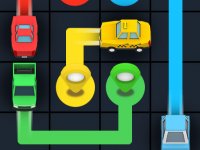
Twin Driver Coordination Racing hands you two vehicles and two sets of controls. Each car responds to its own input—keyboard keys or on-screen buttons—so you cannot simply steer one and let the other coast. The challenge is not speed but divided attention: every barrier you approach must be cleared by both cars, often at the same time. The game ends the moment either vehicle crashes, so a single lapse in focus resets your progress. This dual-input design is the core of the experience and the reason the game feels like a coordination drill rather than a traditional racer.
Track Progression and Obstacle Patterns
Tracks start simple, with wide lanes and predictable obstacle placement. As you advance, the patterns become more complex: barriers may appear in staggered positions, forcing you to weave both cars through narrow gaps. Some levels introduce new obstacle types, though the exact variety depends on how far you progress. Because there is no timer, you can pause and plan your route before committing. That said, the mental load increases with each new layout, and the game expects you to handle both vehicles without letting one fall behind.
Who This Game Suits
This is a family-friendly title aimed at players who enjoy multitasking challenges. It does not require a powerful device or a fast internet connection, making it accessible on most setups. The absence of time pressure means you can practice at your own pace, but the dual-control mechanic still demands focus and regular practice. If you prefer games that test reflexes and coordination without overwhelming visuals or complex rules, this one fits that description. Players who dislike divided-attention tasks may find it frustrating, but those who stick with it can sharpen their reaction time.






Editorial Notes