Prehistoric Chrono-Puzzle Explorer
Reviews
Prehistoric Chrono-Puzzle Explorer builds its puzzles around a single strong idea: your past self becomes a second character you must plan around. The Jurassic setting and time crystals give structure to progression, while the gradual introduction of timed switches keeps the difficulty curve readable. It suits players who prefer deliberate, observation-driven logic over reflex-heavy platforming. The main limitation visible in the input is that dinosaurs remain scenery, so anyone expecting creature encounters may find the threat level lower than the theme suggests.
Description
The Time Rewind Mechanic
Prehistoric Chrono-Puzzle Explorer centers on a time reversal system that records a short window of your movement. Triggering a rewind generates a duplicate of your character that replays those exact actions while you continue playing as the present self. Both entities exist at once, so a switch your past self pressed stays pressed, and a platform your duplicate holds stays held. The puzzle logic depends on sequencing: you must plan what the past self will do before you rewind, because that copy cannot adapt or change course. Experimentation is built into the loop, since a failed sequence simply resets and lets you try a different order.
Jurassic Stage Design
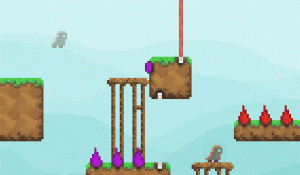
Stages unfold across a lush Jurassic setting of towering ferns, rocky outcrops, and ancient ruins. Side-scrolling levels incorporate moving platforms, crumbling ledges, pressure plates, and movable stones. Dinosaurs appear as scenery rather than active threats, so they add atmosphere without altering puzzle rules. Scattered artifacts and old structures hint at a larger narrative about time and history, though the input does not specify how that story is delivered.
Time Crystals and Progression
Time crystals function as both collectibles and narrative keys. Gathering them unlocks new areas and reveals fragments of a story about the nature of time itself. Many crystals sit in spots that require clever use of the rewind mechanic, which adds a completionist layer beyond simply finishing a stage. Puzzles grow more intricate as you progress, demanding longer coordinated sequences between you and your past self. New elements such as timed switches and moving obstacles raise the timing demands gradually.
Planning Your Approach
Success depends on observation before action. Survey the room to identify which objects need manipulating and in what order, then mentally map the sequence your past self will perform. Rushing tends to misalign the two characters, so patience pays off. If a puzzle stalls, stepping back and testing a different order often exposes the intended solution. Failed attempts are useful because each one clarifies how the copy behaves.








Editorial Notes