Planetary Guardian Defense
Reviews
Planetary Guardian Defense strips the defense genre down to a single orbiting shield and a steady stream of incoming threats. Its strength lies in that simplicity: no upgrades, no story, no clutter, just positioning and timing. The continuous difficulty ramp keeps runs tense without relying on level breaks. Players who enjoy score-chasing and quick browser sessions will get the most from it. Those seeking progression systems or narrative depth will find none here.
Description
Orbital Shield Control
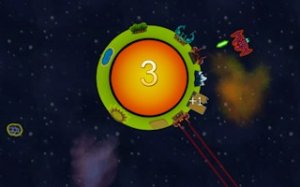
In Planetary Guardian Defense, you take on the role of a planet's protector. Your only tool is a shield that orbits the planet, controlled directly with your mouse or touch-screen. Threats arrive from multiple directions, and your task is to move the shield into their path before they collide with the planet. The control scheme is deliberately simple: point and position. There are no additional buttons, power-ups, or complex commands to learn. That simplicity puts the focus entirely on reading the screen and reacting quickly.
Threat Variety and Escalation
Two types of hazards appear: asteroids and alien ships. Asteroids tend to follow predictable trajectories, while alien ships introduce less predictable movement, forcing you to adjust your positioning on the fly. The game does not use discrete levels or waves. Instead, difficulty rises continuously the longer you survive. Threats come faster, from more directions, and demand quicker decisions. This creates a natural tension curve where every successful block buys you a little more time but also brings you closer to the moment when the screen becomes overwhelming.
Scoring and Risk Management
Each blocked threat adds to your score. The game ends when the planet takes too much damage, so survival and scoring are linked. You cannot afford to ignore any threat entirely, but you also cannot chase every object if two arrive at opposite sides of the planet at the same time. Prioritization becomes a core skill. Larger threats may cause more damage if they connect, so identifying which object to block first is often the difference between continuing and losing. The game rewards calm, deliberate positioning over frantic last-second saves.
Session Design and Accessibility
Planetary Guardian Defense is built for short sessions. A single run can last under a minute or stretch longer as your skills improve. Because it runs in a browser and uses only mouse or touch input, it works on desktop and mobile devices without installation. The clean visual design keeps the planet, shield, and incoming objects easy to distinguish, which matters when several threats appear at once. There is no narrative, no unlock system, and no persistent progression. The appeal is the loop itself: play, fail, recognize what went wrong, and try again with better anticipation.








Editorial Notes