Historical Relic Assembly Puzzle
Reviews
Historical Relic Assembly Puzzle offers a two-stage loop: clean dirt to reveal fragments, then drag them into an outline. The lack of timers or scoring keeps the pace relaxed, while non-rotating pieces add genuine spatial challenge. The educational notes on each artifact are brief and unobtrusive. It suits beginners and puzzle enthusiasts who prefer thoughtful restoration over fast action.
Description
Cleaning and Fragment Discovery
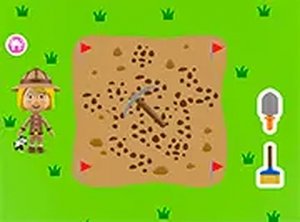
Each artifact starts buried under dirt and debris. Players pick from a collection that spans different eras, then use virtual tools to clear the surface. Clicking or tapping specific areas removes grime and gradually exposes the fragments hidden beneath. The action is simple, but skipping over a patch can leave pieces concealed. This cleaning stage mirrors real conservation work in a simplified form, so the focus stays on careful observation rather than tool mastery.
Assembly and Spatial Reasoning
Once every fragment is visible, the assembly phase begins. Players drag each piece onto a designated outline that represents the complete object. Visual cues suggest where a fragment belongs, but the real task is judging subtle shapes and edges. Pieces do not rotate on their own, so orientation matters. That constraint turns the puzzle into an exercise in spatial reasoning and pattern recognition. Later artifacts contain more intricate fragments, so difficulty rises as the collection progresses.
Historical Context and Educational Value
Artifacts represent various cultures and time periods, from ancient pottery to ornate jewelry. Completing an object triggers a brief description of its historical background. These notes are short and non-intrusive, so they inform without interrupting the puzzle flow. The content suits all ages, with no graphic or disturbing imagery, and the educational layer focuses on preservation and the everyday stories behind historical items.
Interface and Pace
The interface is minimal, with large buttons and clear labels. A progress bar shows how many artifacts remain to be restored. Full-screen mode works on desktop and mobile browsers, and controls stay consistent across devices: touch gestures on tablets, mouse clicks on computers. There are no timers or scoring systems, so players can work at their own pace. That design makes the game approachable for beginners and experienced puzzle fans alike.







Editorial Notes