Hoop Precision Arcade
Reviews
Hoop Precision Arcade focuses on a single skill: judging angle and power with a drag or swipe. The changing court position each round prevents the motion from becoming purely repetitive, and the choice between a one-point and two-point hoop adds a small but real decision. Score tracking after five attempts gives structure without clutter. It suits players who want a quick browser or mobile distraction rather than a deep sports simulation. The main limitation is that the input describes only this core loop, so variety comes from position and hoop choice rather than from teams, seasons, or player management.
Description
Shooting by Drag and Swipe
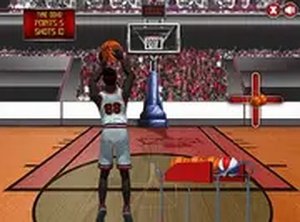
Every round starts with your player standing at a fixed spot on the court. You set the shot by dragging or swiping: the motion determines both the angle and the power of the throw. When you release, the ball travels toward the hoop, and the result is shown immediately. Because the input is direct, each attempt gives clear feedback about whether your aim and strength were correct. There is no separate aiming meter to watch or hidden timing window to learn.
One-Point and Two-Point Hoops
Two basket types are available during play. A standard hoop is worth one point; a special hoop is worth two. The decision between them is the main strategic choice in each round. A two-point attempt can lift your score faster, but the one-point option is the safer fallback when your position or confidence makes the extra risk unappealing. This keeps the scoring system simple while still asking you to weigh reward against reliability.
Changing Court Positions
Each round places you at a different location on the court. Some spots are close to the basket, while others sit farther out. Because the distance changes, you cannot reuse the same drag or swipe motion every time. You have to adjust angle and power to match the new position. Over repeated rounds, this builds a practical feel for how much force a given distance requires and how much arc a shot needs.
Built for Short Sessions
The game loads directly into play. There are no complex menus or lengthy tutorials standing between you and your first shot. Controls work with a mouse on desktop or a touch screen on mobile, and a full-screen mode is available for a more focused view. That structure suits short breaks as well as longer practice sessions, because a round is defined by five attempts rather than a fixed time limit or story chapter.
Score Tracking Across Rounds
After each round, your score is displayed, showing how many points you earned from your five attempts. This gives you a simple way to measure consistency: you can compare one round against another, try to beat your previous best, or just watch whether your shooting accuracy improves over time. The scoring system stays minimal, so personal goals are easy to set without tracking multiple stats or currencies.








Editorial Notes