Temple Block Puzzle
Reviews
Temple Block Puzzle focuses on observation and planning rather than speed. The combination of gravity, explosive tiles, and bounce surfaces gives each level a distinct solution path, and the absence of a timer encourages experimentation. Early puzzles teach the rules, later ones test them. It suits casual players and puzzle fans who prefer thinking over reacting. The main limitation is that the input does not describe additional modes or variety beyond the core puzzles.
Description
Releasing Blocks and Reading Gravity
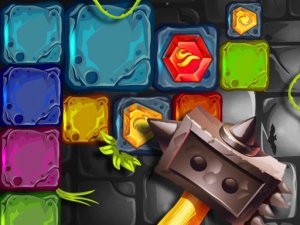
Each puzzle begins with green blocks held in place. Clicking or tapping a block releases it, and gravity immediately pulls it downward. The central task is to move those blocks into specific target areas. Because the blocks fall rather than slide freely, the order in which you release them matters as much as where they start. A block released too early can block the path of another, so observation comes before action.
Explosive Tiles and Bounce Surfaces
Direct falls rarely solve a level on their own. Explosive tiles push blocks in a chosen direction, letting you reach high or distant platforms that gravity alone cannot. Bouncing surfaces redirect a falling block's trajectory, turning a straight drop into an angled approach. These two elements turn each layout into a small physics problem: you are not just dropping blocks, you are deciding when and how to alter their path.
Level Structure and Pacing
Early levels introduce the basic controls and physics step by step, so new players can learn how blocks behave before facing more complex arrangements. Difficulty rises gradually through a series of puzzles, each with its own layout. The interface stays simple and clean, keeping attention on the board. Since there is no time limit, there is no penalty for pausing to study the level or trying a different order of moves.
Who This Suits
Temple Block Puzzle is built for players who enjoy logic and physics brain teasers at a relaxed pace. The temple setting adds atmosphere without changing the mechanics. Visual feedback confirms when a block lands in a target area, so progress is always clear. It is family-friendly and accessible to casual players, yet the later layouts offer enough resistance for experienced puzzle fans.







Editorial Notes